

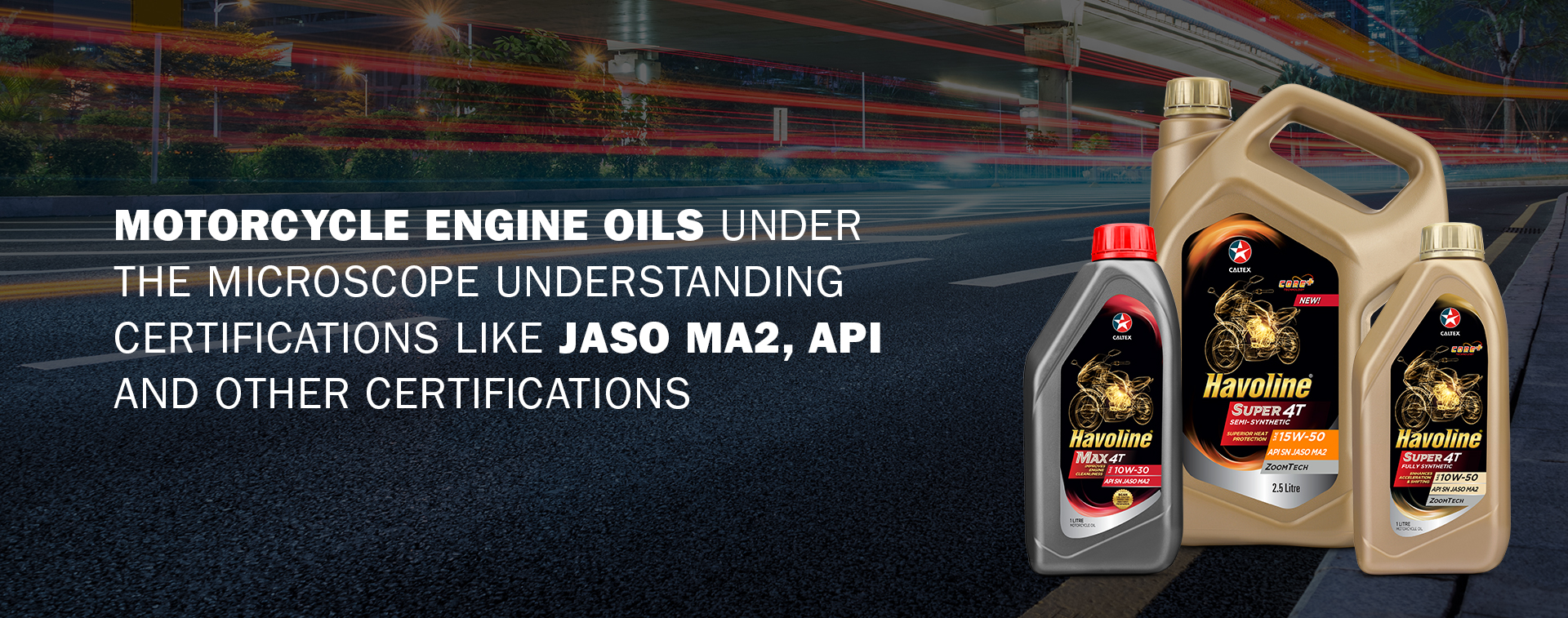
Motorcycle Engine Oils Under the Microscope: Understanding Certifications like JASO MA2, API and Others.
Published by: Chevron Technology | 23-Mar-2026
When buying engine oil for a motorcycle, many of us check the brand, cost, properties, and viscosity grade listed on the oil’s packaging. One such piece of information that should be included in the list of considerations is the certifications or standards for the oils issued by reputable organisations.
Have you heard of terms like API and JASO MA2 when it comes to engine oil? Yes, we are talking about those very terms. These certifications indicate how well an engine oil withstands adverse conditions, such as drastic temperature variations and sludge formation. These certifications also ensure that the engine oil is tested against various standards to verify that its quality and performance meet the benchmarks set by lubricant and engine manufacturers.
Here, we will delve into studying these standard engine oil certifications in detail and how they impact the performance and durability of a motorcycle engine as a whole.
Decoding the API Classification
Primarily intended for engines engineered in the American motoring industry, the American Petroleum Institute (API) classification is one of the most widely adopted engine oil specifications for motorcycle engines worldwide. The API specifications are denoted by a two-letter term following ‘API’ on an engine oil’s packaging, which starts with ‘S’ for petrol engines and ‘C’ for diesel engines.
In the context of motorcycles, only the two-letter terms starting with ‘S’ are considered, indicating grades for spark-ignition/petrol engines. The second letter after ‘S’ in the API classification suggests the level of oil performance based on advancements in engine oil technology over the past few decades. These specifications differ based on wear protection, oxidation control, and detergency level.
Following are all the API specifications that have been in use in all these years of the motorcycle industry, which only offered improved resistance to oxidation, stress due to high temperatures and wear with every succeeding specification:
- API SA: Introduced in 1930
- API SB: Designated for engines made in the 1940s and 1950s
- API SC: Introduced in 1964 for motorcycle engines of the 1960s
- API SD: Introduced in 1968 for motorcycle engines made in the late 1960s
- API SE: Existed in the early 1970s
- API SF: It came into existence in the early 1980s
- API SG: Introduced in the late 1980s and remained in effect till the early 1990s
- API SH: Remained in effect for a short time in the mid-1990s
- API SJ: Introduced in the mid-1990s for engines produced till the late 1990s
- API SL: Began a new era in the early 2000s, offering better high-temperature protection for engines made till the mid-2000s.
- API SM: It rolled out in the mid-2000s and remained in existence till the early 2010s
- API SN: A standard introduced in the early 2010s and remained in action till the late 2010s
- API SP: Introduced in 2020; the first to include robust protection against LSPI, improved timing chain wear protection, and better high-temperature performance.
- API SQ: It is the most recent classification, Introduced in March 2025; builds on SP with further enhancements including even better fuel efficiency (up to 16% improvement), superior protection against both fresh and aged oil LSPI, and enhanced piston deposit control.
JASO Certification Explained
Another widely accepted certification for motorcycle engine oils worldwide, the Japanese Automotive Standards Organisation (JASO) certification is primarily applied to motorcycles equipped with wet clutches.
Initially, JASO certification was introduced to address quality standards in the Japanese two-wheeler market. However, it gradually began to be accepted in other global markets, continuing to set benchmarks for the protection of engine components and wet clutches at higher speeds.
Breaking Down JASO Standards (T903 Specification)
For four-stroke motorcycles, JASO developed T903 standards, which categorise components based on clutch compatibility and performance. These categories are defined by tests that measure friction coefficient to prevent clutch slipping, anti-wear properties to protect engine components, and stability at higher temperatures to maintain performance under high-heat, high-stress conditions.
These categories of JASO standards are as follows:
- JASO MA: The basic-level category for motorcycle oil, ensures the smooth operation of wet clutches and avoids the possibility of clutch slippage in motorcycles.
- JASO MA1: Motorcycle engine oils in this category offer a balanced friction level, making them equally suitable for both low-speed commuting and high-speed riding. Most motorcycles are compatible with the JASO MA1 specification.
- JASO MA2: Explicitly preferred for high-performance, large-capacity motorcycle engines, assuring better wet clutch performance even during aggressive riding.
- JASO MB: Oils in this category are primarily designed for scooters, offering optimal performance in terms of thermal stability, oxidation resistance, and improved fuel efficiency.
Comparison: JASO MA vs. JASO MA2
In general, JASO MA2 is considered a more advanced grade than JASO MA, and is better suited for motorcycles with high-performance engines or that frequently operate under heavy loads. However, both these JASO oil grades differ from each other in a few aspects, which are as follows:
Friction Level: Compared to JASO MA, which has a broader range of friction coefficient values, JASO MA2 has a narrower range, enabling more efficient clutch operation.
Engine Compatibility: With their higher friction values, JASO MA is suitable for entry-level commuters, while JASO MA2 is better suited to high-performance motorcycles that demand more instantaneous and precise clutch operation.
Advantages in the Real World: While JASO MA prevents clutch slipping and ensures balanced performance for daily riding patterns, JASO MA2 enhances gear shifts under high stress and maximises clutch grip by reducing the possibility of clutch fading.
Why JASO MA/MA2 Matters for Wet Clutches
The motorcycles that come with wet clutches in their transmission assemblies have their clutch plates completely immersed in the same engine oil that also lubricates the engine and gearbox. Due to its multi-tasking nature, the engine oil operates under higher stress levels to keep both the engine and transmission assembly in check. If it fails to do so, the motorcycle rider may experience reduced power delivery, accelerated clutch wear, and clutch slipping.
The JASO MA and JASO MA2 certifications ensure that the engine oil maintains a balanced friction level, preventing clutch slipping. At the same time, the higher friction requirements of JASO MA2 oils facilitate stronger, more precise clutch operation, allowing high-performance motorcycles to be ridden aggressively.
Are JASO MA and MA2 Oils Safe for Catalytic Converters?
To meet the latest, stricter-than-ever emission norms, modern motorcycles have sophisticated emission systems featuring advanced catalytic converters to reduce pollutants emitted from the exhaust pipe. There are specific properties of JASO MA and JASO MA2 engine oils which make them not only safe but highly recommended for motorcycles with new-age catalytic converters, which are as follows:
- JASO MA and JASO MA2 lubricant oils contain advanced additives that reduce the deposition of sulphur and phosphorus on the outer coating of catalytic converters, thereby preventing a drop in their efficiency.
- JASO MA and JASO MA2 engine oils have balanced levels of zinc dialkyl-dithio-phosphate (ZDDP) and friction modifiers, as an excess of these additives can also clog the catalytic converters and poison them.
- Nowadays, almost all JASO-certified engine oils are also API SN- or API SP-rated, meeting a wider range of international standards.
Conclusion: Why Engine Oil Certifications are Necessary?
Think of the performance and reliability of a motorcycle’s engine as a coin, and you will realise that the viscosity levels and proper certifications are the two sides of that coin. While viscosity grades of a lubricant oil determine the engine’s cleanliness and smoothness in the way it runs in action, the API certifications improve the engine’s protection, and the JASO certifications enhance the wet clutch’s performance. Based on your motorcycle’s manufacturer, consider using engine oil with suitable API or JASO grades (or both) to ensure optimal engine and transmission performance.
FAQs
What are JASO and API?
The Japanese Automotive Standards Organisation (JASO) certification is specifically applicable to motorcycles and ensures the smooth lubrication of engine and transmission components, such as gearboxes and wet clutches. On the other hand, the American Petroleum Institute (API) applies to both cars and motorcycles, focusing primarily on improving oxidation stability and wear resistance of the engine.
How can I determine whether an oil is JASO-certified?
An engine oil’s JASO certification is mentioned on its outer packaging as ‘JASO MA’, ‘JASO MA1’, ‘JASO MA2’ or ‘JASO MB’, along with a JASO registration code, which you can verify on JASO’s official website.
What is ACEA oil?
Similar to API sets performance standards for engine oils in the American context and to JASO in the Japanese context, the Association des Constructeurs Européens d’Automobile (ACEA) sets performance standards for engine oils in European countries.
Which API certification is recommended?
Given their relevance to minimising oxidation and wear in engines produced in recent years, API SN and SP certifications are recommended for vehicles.
This Article is written by Chevron Technologies In Collaboration with Industry Expert