

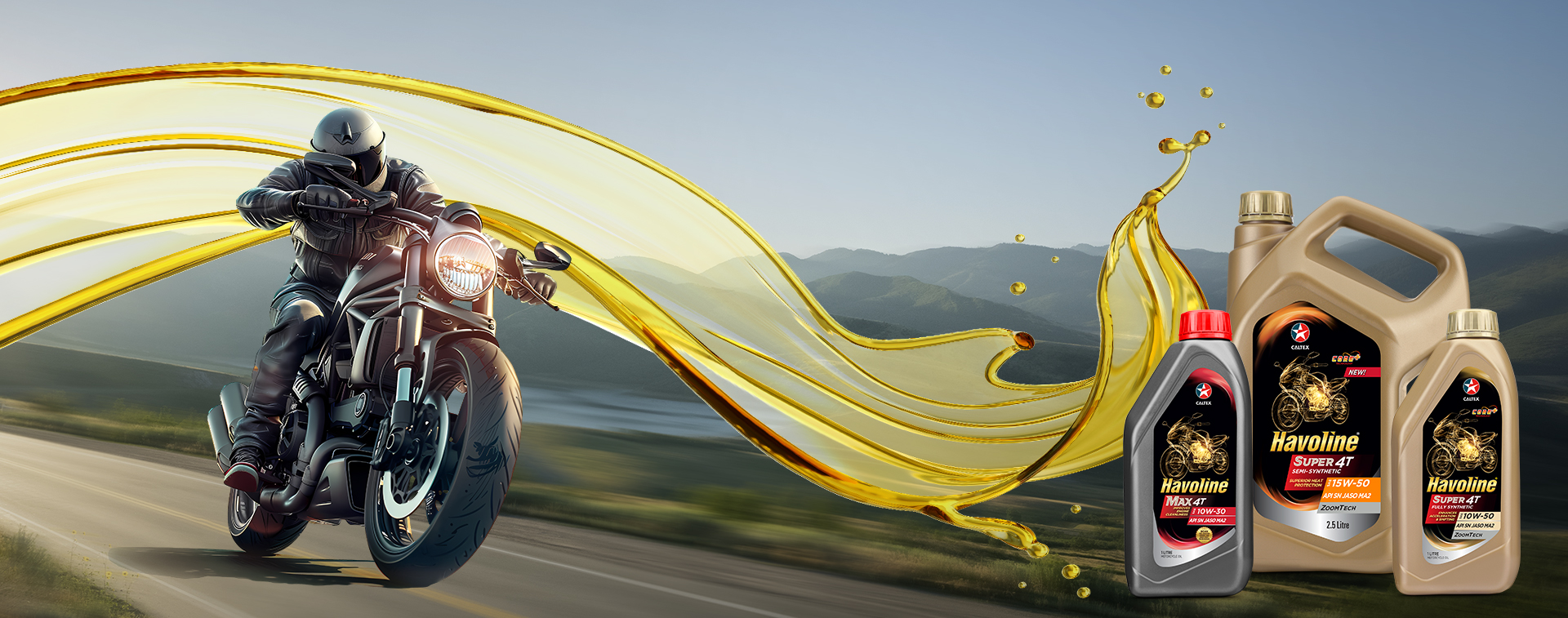
What is Motorcycle Engine Oil: How and Why is it Different from Car Oil
Published by: Chevron Technology | 23-Mar-2026
Flows like blood through veins and organs and keeps them healthy in the long run – that’s what motorcycle engine oil is to fast-moving components of a powertrain. Whether the motorcycle engine is singing to its fullest at higher RPMs or even hums at idle, the engine oil keeps it calm by reducing friction between its components.
Like the internal combustion engines of a motorcycle and a car, their engine oils also differ in various ways. And it is those differences which we will be discussing here.
How Are Car and Motorcycle Engines Different?
All modern internal combustion engines for cars and motorcycles use the four-stroke combustion process. However, both differ significantly in size, configuration, transmission integration, and the type of lubrication used for their internal components.
- Car engines are usually large, featuring three to twelve cylinders. On the other hand, motorcycle engines, generally with one to four cylinders, are relatively small but offer a higher power-to-weight ratio.
- While car engines are typically liquid-cooled, motorcycle engines are either air-cooled or liquid-cooled.
- Cars have an engine and a transmission as separate units, each with its own lubrication system. On the other hand, motorcycles have engines and transmissions integrated within a single housing, sharing the same lubricant.
Motorcycle Oil vs Car Engine Oil: What’s the Difference?
The core purpose of both motorcycle engine oil and car engine oil is the same – to lubricate the internal components of their engines. However, it is their properties and ways of action that set them apart.
- A car engine oil lubricates only the internal components of the engine, while a separate oil lubricates the transmission, as both engine and transmission are not housed in a single unit. On the other hand, motorcycle engine oil lubricates the engine, transmission, and clutch simultaneously.
- Compared to motorcycle engine oils, car engine oils contain higher levels of friction modifiers to improve fuel efficiency. However, high levels of friction modifiers can adversely affect wet clutch performance and may accelerate wear of clutch and transmission components.
- Since motorcycles have engines and transmissions in a single housing, their engine oils should exhibit greater shear stability to withstand the additional mechanical stress imposed by multiple components.
- While car engine oils use additives primarily for cleaning and emissions control, motorcycle engine oils have additives to withstand dramatic temperature spikes at higher RPMs.
Types of Motorcycle Engine Oil Explained
Like engine oil for cars, motorcycle engine oils are also primarily of three types, which are as follows:
Mineral Oil
Also known as conventional oil, this is the most basic form of engine oil, extracted from crude petroleum with the simplest processing. While this engine oil is the most affordable of all types, its breakdown rate is faster at higher temperatures. As a result, their replacement frequency is the highest.
Synthetic Engine Oil
Instead of being extracted from crude petroleum, this engine oil is prepared synthetically from uniform chemical molecules. These engine oils have exceptional thermal stability, making them efficient and composed even at higher operating temperatures.
Semi-synthetic Engine Oil
A mixture of both mineral oils and fully synthetic oils, semi-synthetic oils have the properties of both refined oil from crude petroleum and chemically formulated oils prepared in laboratories.
These oils are relatively affordable than fully synthetic engine oils and offer better heat resistance than conventional mineral oils. However, their durability and efficiency are lower than those of fully synthetic oils.
Which Engine Oil Should You Use in a Motorcycle?
Depending on OEM recommendation and their composition and efficiency, all three types of engine oils are best suited for different categories of motorcycles.
- Conventional motorcycle engine oil is suitable for small-capacity, low-performance, economic-centric engines for entry-level motorcycles.
- Due to their excellent stability and composure at higher temperatures, fully synthetic oils are most suitable for performance-oriented motorcycles like range-topping sports bikes and heavy cruisers.
- As they offer the characteristics of both conventional and fully synthetic engine oils, semi-synthetic oils are best for mid-range motorcycles that balance performance and efficiency, especially motorcycles belonging to 300-650cc categories.
Is Synthetic Oil Better for Your Motorcycle?
While synthetic oils are preferable for high-performance motorcycles, they are also compatible with entry-level and mid-range motorcycles.
- With rising global temperatures and traffic congestion, motorcycles today demand engine oils that do not break down easily at higher operating temperatures. For that, fully synthetic oils are the best bet.
- Synthetic engine oils also have the best lubrication properties in colder regions, making them more suitable for a motorcycle that frequently witnesses cold starts.
- The sludge formation rate is lowest with fully synthetic oil, so there is no need for more frequent replacements, resulting in longer service intervals.
What Happens If You Use Car Oil in a Motorcycle?
The variations in properties and chemical composition between motorcycle and car engine oil make the latter unsuitable for use in motorcycles.
On motorcycles with a wet clutch, where the clutch assembly is immersed in engine oil, higher levels of friction modifiers in car oil can lead to frequent clutch slipping. It can lead to poor, inconsistent acceleration or even clutch overheating.
As mentioned above, motorcycles have engines and transmissions in a single housing. Using car oil in a motorcycle engine can increase gear wear, as it is not formulated to withstand the high shear forces between the components of a motorcycle transmission.
Performance motorcycles have high-revving engines that run hotter, where a car engine oil might not perform as well as it should. It can increase friction, leading to overheating.
Conclusion
Before selecting the right engine oil for your motorcycle, it is advisable to understand its properties and how well it can enhance performance and efficiency. Motorcycle engine oils have the responsibility of not only the engine but also the transmission and clutch’s working efficiency. And that’s where an all-around performer like the Caltex Havoline Max 4T feels like the perfect match for your motorcycle.
FAQs
What are the two main types of engine oil?
Motorcycles usually have two main types of engine oil for their powertrains: conventional (mineral) oil and fully synthetic oil. Nowadays, semi-synthetic engine oils, which offer the properties and benefits of both mineral and fully synthetic oils, are also available.
Can I use car engine oil in a motorcycle?
No, using car engine oil in a motorcycle will accelerate the wear rate of internal components, particularly those of the transmission. It also causes poor acceleration and clutch overheating due to frequent slipping.
What happens if I accidentally use car oil in a bike?
Using car engine oil might not lead to sudden breakdown or overnight damage to the motorcycle engine. Instead, it will deteriorate the engine's internal components, resulting in higher maintenance costs.
How often should I change motorcycle engine oil?
It entirely depends on the recommendations issued by a motorcycle's maker. Motorcycle engine oil usually needs to be changed at least once a year, and the manufacturer may specify an odometer limit if it comes earlier.
This Article is written by Chevron Technologies In Collaboration with Industry Expert